Precision Matters: Weight vs. Volume
Field notes / 015
Precision Matters: Weight vs. Volume
Why are most of the baking recipes on this blog measured in weight instead of volume? Why should I weigh my ingredients?
The short answer
Baking is just as much a science as it is an art. Small variations in measurements can throw off your baking and lead to un-wanted results (dry cake, tough cookies, etc.) Weighing your ingredients helps eliminate one of the biggest variables in baking.
What’s actually happening
Adding five cloves of garlic instead of three to your mashed potatoes won’t fundamentally alter the mashed potatoes. However, add an extra 1/2 cup of milk to your cake recipe, and your cake could collapse when you take it out of the oven.
Why? Baking is just as much science as art. The art comes in the flavor pairings, the presentation, the decoration. But to get there, first you need to understand the science.
Baking depends on ratios, chemical reactions, and timing. Throw one of those off, and you have a disaster:
- Flour: Too much can produce dry, dense, or tough baked goods.
- Sugar: Affects sweetness, moisture retention, browning, and texture.
- Butter and other fats: Influence tenderness, richness, and structure.
- Liquids: Affect hydration, batter consistency, and dough development.
- Leavening agents: Small measurement differences can affect rise and texture.
This comes into play when making substitutions as well, but that’s a whole other Baking Lab post.
See for yourself
Grab your container of flour, a measuring cup, a few bowls and a kitchen scale.
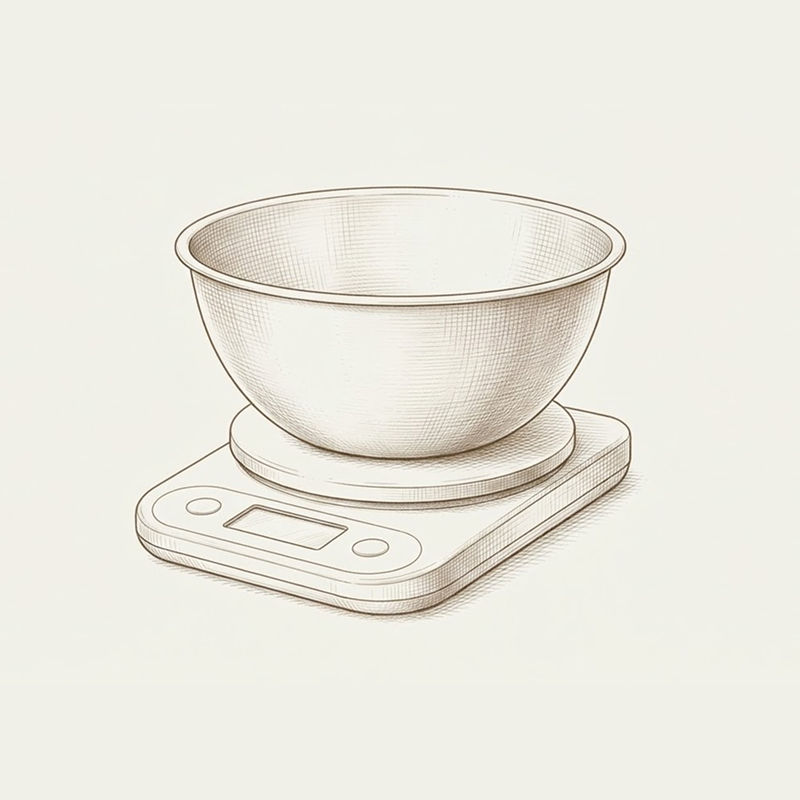
Scoop a cup of flour and level it off. Place the bowl on top of the scale, and then turn it on (or press the “Tare” or “Zero” button if you had already turned it on — this ensures you don’t add the weight of the bowl to the weight of the flour). See how much the flour weights.
Now, aerate the flour (stir it with a fork or whisk), then scoop some flour and level it off. See how much that cup of flour weighs.
Finally, spoon the flour into your measuring cup and level it off. See how much that cup of flour weighs.
Were all your measurements different?
A cup of flour weighs between 4 ounces and 4.5 ounces, depending on the type of flour (for example, cake flour weighs less than all-purpose flour). I used flour in this experiment because it’s one of the trickier ingredients to measure by volume. It can become compacted during transit and packing. Whether you dip your measuring cup in the sugar, or spoon sugar into your measuring cup, it’s going to weigh more or less the same.
When testing my recipes, I use the King Arthur Baking Company’s ingredient weights.
Accuracy is not the only benefit
Scaling recipes up or down becomes so much easier when you measure your ingredients by weight instead volume.
Say you found the perfect cake recipe, but it calls for 9-inch round cake pans, and you only have 8-inch round cake pans. If you try to bake the batter for the 9-inch rounds in your smaller pans, well, you’re going to have a mess to clean up when it overflows in your oven.
But it’s not as simple as cutting the recipe in half! Nine-inch round pans hold 8 cups of batter, while 8-inch rounds only hold 6 cups. If the 9-inch round recipe calls for 2.75 cups of cake flour, and you need to reduce your recipe by 25%, well, that’s more math than I want to do now that I’m out of school.
But if you weigh your ingredients, the 9-inch round calls for 11.7 ounces (330 grams) of cake flour, and reducing that by 25% leaves you with 8.75 ounces (247 grams)! No wondering if they make 11/16 measuring cups.
In your kitchen
- Weigh your ingredients. It really is the key to better baking. I use the OXO 11-pound kitchen food scale, because I tend to make large batches of cookies and buttercream. I also like the pull-out display if I’m using an extra-large bowl, or measuring onto a sheet pan. The less-expensive Escalio food scale is also a great choice (and comes in more colors!).
- There’s less to wash later. If you’re making, say, cookies, you can measure all the dry ingredients right into the same bowl. Then you have one bowl to wash later, rather than several measuring cups and spoons.
- Don’t overthink it, though. Yes, small measurements can make a difference. But if a recipe calls for 8.5 ounces of flour, and you measure out 8.6 ounces, it’s fine. Really.
Weighing ingredients helps eliminate one of the biggest variables in baking.
Put it to work
Stay curious, Coleen